June 15, 2026
Why a Maths Workbook is Better Than a Maths Textbook
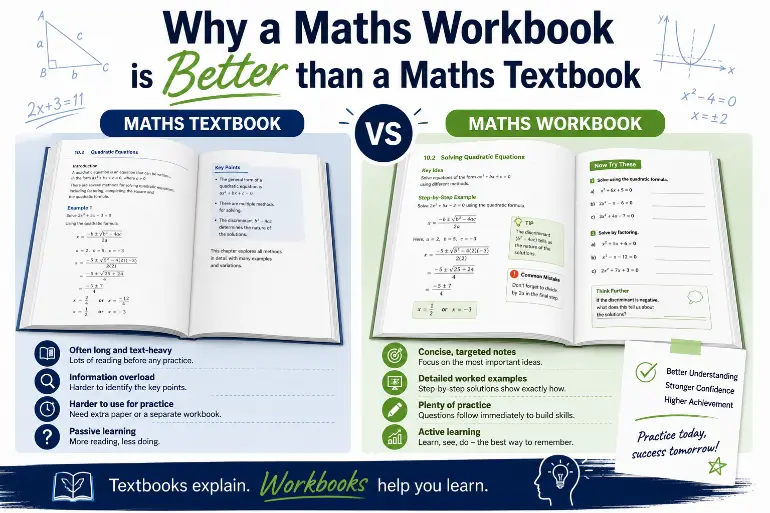
For generations, maths textbooks have been a staple in classrooms. They provide comprehensive explanations and reference material, but when it comes to helping students develop mathematical understanding and improve achievement, a workbook often delivers greater value.
A quality maths workbook combines concise notes, detailed worked examples, and carefully structured practice activities, making it a powerful learning tool for students of all ability levels.
Maths is a Skill, Not Just Knowledge
Imagine trying to learn to play the piano by reading a book about music. Or learning to ride a bike by studying diagrams.
You might understand the theory, but without practice, you won't develop the skill.
Mathematics works in much the same way.
Students don't become confident mathematicians by reading explanations alone. They develop understanding by solving problems, recognising patterns, and applying concepts repeatedly.
A workbook encourages active participation, while a textbook often encourages passive reading.
Concise Notes Focus on What Matters Most
One challenge many students face with traditional textbooks is information overload.
Textbooks are often designed to be comprehensive, containing lengthy explanations, multiple teaching approaches, and extensive reference material. While useful, this can sometimes make it difficult for students to identify the key ideas they need to learn.
A well-designed workbook presents concise, targeted notes that focus on the essential concepts and methods students need to understand.
Rather than reading several pages to find the important information, students can quickly access clear explanations that support learning and revision.
This streamlined approach makes learning more efficient and less overwhelming.
Worked Examples Show Students Exactly How to Solve Problems
One of the most effective ways to learn mathematics is by studying worked examples.
Before attempting questions independently, students benefit from seeing:
- The correct method
- Each step in the solution process
- Common mistakes to avoid
- How mathematical reasoning is applied
Quality workbooks include detailed examples that guide students through the thinking behind each solution.
These examples act as a bridge between learning a new concept and applying it independently.
For many students, seeing a problem solved step-by-step builds confidence and reduces anxiety when tackling similar questions themselves.
Learning Through Practice
The greatest strength of a workbook is that it immediately follows instruction with application.
Students can:
- Read concise notes
- Study worked examples
- Practise similar questions
- Build confidence through repetition
This "learn, see, do" structure mirrors how people naturally develop skills.
Instead of constantly switching between a textbook, exercise book, and notes, students have everything they need in one place.
Better for Building Confidence
Confidence is one of the strongest predictors of success in mathematics.
Students gain confidence when they experience success, and success comes through guided practice.
Workbooks are typically structured with a gradual progression of questions, allowing students to:
- Start with straightforward exercises
- Build mastery step by step
- Develop fluency before tackling more challenging problems
As students see their improvement over time, they become more willing to tackle new concepts and persevere through challenges.
More Effective for Homework and Revision
When students are asked to revise, many are unsure where to begin.
Textbooks often contain hundreds of pages of content, making revision difficult and time-consuming.
Workbooks provide a clear pathway for review.
Because key notes, examples, and exercises are located together, students can quickly refresh their understanding before practising questions.
This makes revision more focused, efficient, and effective.
Supports Long-Term Retention
Research consistently shows that students retain knowledge more effectively when they regularly revisit and practise concepts.
A workbook naturally supports this process by combining explanation, demonstration, and practice in a single resource.
Each completed exercise strengthens understanding and reinforces previously learned concepts.
Over time, this repeated exposure helps students develop deeper understanding and stronger recall than reading alone can provide.
Final Thoughts
Textbooks explain mathematics. Workbooks help students learn it.
By combining concise notes, detailed worked examples, and structured practice activities, a maths workbook provides students with everything they need to understand new concepts and apply them confidently.
For students who want to improve achievement, strengthen retention, and build confidence, a workbook offers a practical, engaging, and highly effective pathway to success. 🌈✨
Leave a Comment
Please note - comments need to be approved before posting.