February 1, 2026
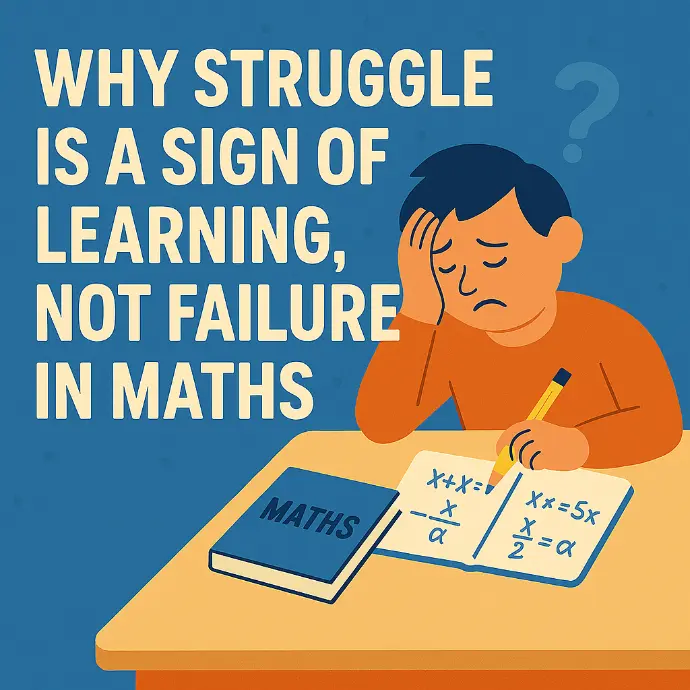
Why Struggle is a Sign of Learning Not Failure
A reassuring message for students and parents
Maths can be tough. There’s no sugar-coating it - sometimes it feels like your brain is doing gymnastics just to understand a single idea.
But here’s the truth that every student and parent needs to hear: Struggle is not a sign of failure. It’s a sign of learning.
In fact, productive struggle - the kind that stretches thinking without overwhelming - is one of the most powerful tools for building deep, lasting understanding.
Let’s explore why.
Learning Happens at the Edge of Comfort
Think about learning to ride a bike. You wobble. You fall. You try again. Eventually, your brain and body figure it out - not because it was easy, but because it was challenging.
Maths works the same way.
When students feel a bit stuck, their brains are actively working to make sense of new ideas. That’s where learning lives - right at the edge of what’s comfortable.
Struggle Builds Brain Connections
Research shows that when students wrestle with a problem - even if they get it wrong - their brains form stronger connections than if they were simply told the answer.
It’s like building muscle: Effort strengthens understanding.
So when a student says, “This is hard,” we can say, “That means your brain is growing.”
Mistakes Are Feedback, Not Failure
In maths, mistakes are often seen as something to avoid. But mistakes are actually valuable clues.
They show:
- what a student understands
- where the thinking went off track
- what needs to be revisited
When students learn to treat mistakes as part of the process - not proof they’re “bad at maths” - their confidence grows.
Struggle Builds Resilience and Independence
Students who learn to persist through difficulty develop:
- problem-solving skills
- emotional resilience
- a growth mindset
- the ability to learn independently
These are life skills, not just maths skills.
And they start with the simple message: “It’s okay to struggle. Keep going.”
Parents Can Support Without Solving
When a child is stuck, it’s tempting to jump in and fix it. But the most powerful support is encouragement, not answers.
Try saying:
- “What do you already know?”
- “Can you show me your thinking?”
- “Let’s look at the example together.”
- “It’s okay to be stuck - that means you’re learning.”
This helps students stay in the struggle zone - where real learning happens.
Teachers Can Design for Productive Struggle
Not all struggle is helpful. If a task is too hard or too vague, students shut down.
That’s why NuLake books are carefully scaffolded - they build challenge gradually, with:
- clear examples
- step-by-step progression
- varied practice
- real-world contexts
This helps students stay engaged, even when the work is tough.
Struggle Today Leads to Confidence Tomorrow
Ask any confident maths student how they got there, and they’ll tell you: “I didn’t always understand it. I had to work at it.”
Confidence isn’t the absence of struggle. It’s the result of struggle - faced, managed, and overcome.
Final Thoughts: Let’s Redefine What Success Looks Like
Success in maths isn’t about getting everything right the first time. It’s about showing up, trying again, and learning through effort.
When we teach students - and remind parents - that struggle is normal, valuable, and even necessary, we build a culture of resilience.
And that’s how real learning happens.🌈✨
Leave a Comment
Please note - comments need to be approved before posting.