June 1, 2026
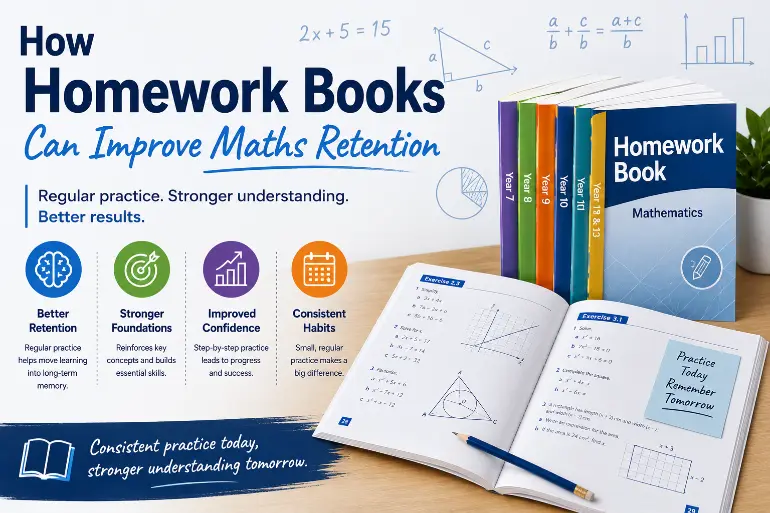
How Homework Books Can Improve Maths Retention
Mathematics is a subject that builds on itself. Each new concept relies on understanding previous skills, making long-term retention essential for success. While classroom instruction provides the foundation, students often need regular practice outside of school to strengthen their understanding and retain what they have learned. This is where homework books play a valuable role.
A well-designed maths homework book does more than provide extra questions - it helps students develop consistent study habits, reinforce learning, and improve retention over time.
Why Maths Retention Matters
Many students understand a mathematical concept when it is first taught but struggle to recall it weeks or months later. This is a common challenge because our brains naturally forget information that is not revisited regularly.
In mathematics, forgetting key concepts can create learning gaps that make future topics more difficult. For example, students who struggle with fractions may find algebra and probability more challenging later on.
Regular review and practice are essential for moving mathematical knowledge from short-term memory into long-term memory.
The Science Behind Retention
Research shows that students learn more effectively when they revisit concepts over time rather than trying to learn everything in a single session. This approach, known as spaced practice, strengthens memory and improves recall.
Homework books naturally support this process by encouraging students to:
- Review previously learned concepts regularly
- Apply skills in different contexts
- Practise over weeks and months rather than cramming before assessments
- Build confidence through repetition and success
Consistent exposure helps students retain mathematical knowledge for longer and apply it more effectively when needed.
Reinforcing Classroom Learning
Students are exposed to a large amount of information during each school week. Without opportunities to revisit concepts, much of that learning can fade quickly.
Homework books provide structured reinforcement by allowing students to:
- Practise newly learned skills shortly after lessons
- Consolidate understanding through repetition
- Identify areas that need additional support
- Develop independence in their learning
This reinforcement strengthens the connection between classroom instruction and long-term understanding.
Building Strong Mathematical Foundations
Every maths topic builds on prior knowledge. Students who regularly practise core skills are better prepared to tackle more advanced concepts.
Homework books help reinforce foundational skills such as:
- Number operations
- Fractions and decimals
- Algebraic thinking
- Measurement
- Geometry
- Statistics
By continually revisiting these concepts, students create a stronger foundation that supports future learning.
Encouraging Active Learning
Reading notes or watching explanations can be helpful, but mathematics is ultimately a skill-based subject. Students learn best when they actively solve problems themselves.
Homework books encourage active engagement by requiring students to:
- Apply mathematical methods
- Work through problems independently
- Check their understanding
- Develop problem-solving strategies
This active participation strengthens memory far more effectively than passive review alone.
Developing Consistent Study Habits
One of the greatest benefits of homework books is that they encourage regular practice.
Even spending 10 - 15 minutes on maths a few times each week can have a significant impact on retention. Small, consistent study sessions are often more effective than long periods of revision before tests or exams.
Students who develop regular homework routines often experience:
- Improved confidence
- Better organisation
- Reduced assessment stress
- Greater academic independence
These habits support success not only in mathematics but across all areas of learning.
Supporting Success
For secondary school students, strong retention is particularly important for achievement. Many assessments require students to draw upon knowledge and skills developed over several years.
Homework books can help students:
- Review key concepts throughout the year
- Prepare effectively for internal and external assessments
- Strengthen areas of weakness before exams
- Build confidence through ongoing practice
Students who engage in regular revision are often better prepared to perform under assessment conditions.
How Parents Can Help
Parents do not need to be maths experts to support retention. Simple actions can make a meaningful difference:
- Encourage regular homework routines
- Provide a quiet study environment
- Celebrate effort and persistence
- Help students stay organised
- Encourage questions when challenges arise
Consistency and encouragement often have a greater impact than direct instruction.
Final Thoughts
Mathematics is not learned through a single lesson or a last-minute study session. Long-term success comes from regular practice, reinforcement, and revisiting concepts over time.
Homework books provide a practical and effective way to strengthen maths retention, helping students build confidence, develop strong foundations, and achieve better outcomes in the classroom and beyond.
By making maths practice a regular habit, students can transform short-term understanding into lasting knowledge that supports their success for years to come. 🌈✨
Leave a Comment
Please note - comments need to be approved before posting.